Showing posts with label Plymouth - Massachusetts. Show all posts

Thursday, June 26, 2014

Burial Hill in Plymouth, Massachusetts

If you're visiting Plymouth and want to take in all of the town's historic sites, you make sure you climb Burial Hill and take in the history and the sites of this historic cemetery.

If you are visiting the Plymouth, Massachusetts area, one place you should not miss is Burial Hill. This hill, located above the downtown area is home to the graves of Plymouth's first residents the Pilgrims, along with other notable residents. The hill also provides a nice view of the village below and Plymouth Harbor beyond. On a clear day you can get quite the view of the surrounding village and the ocean.

Getting There

Burial Hill is easy to access. The cemetery is part of the Pilgrim Trail which travels throughout Plymouth (including stops at Plymouth Rock, Pilgrim Memorial State Park, Mayflower II and the Brewster Gardens), is accessible from the First Parish Church and from side side streets on the northern side of the hill. Parking can be a bit difficult in general in Plymouth so it's probably just best to walk to the Hill from wherever you can find a parking spot.

Some of the access walks are a bit steeper than others. The one that travels up from the Grist Mill area has a pretty decent slope and then some stairs and the one from the First Parish Church comes up several flights of stairs. I would think that in general, the site isn't all that handicapped friendly since even the paved walkways that avoid the stairs can have quite the slope.

The cemetery is open from dusk to dawn.

What to expect

The hill is a do-it-yourself kind of destination. There are a few interpretive signs around the site and on specific graves but in general, this is the kind of place you just wander around and find interesting things.

You'll see plenty of graves of all ages since people had been buried on the hill from the time of the Pilgrims right through the 1950s. The hill was also the site of the first fort and meeting house in Plymouth.

Expect to spend about an hour wandering through the graves. You'll find tombstones from all different eras and it's interesting to see how the gravestones have changed throughout the years.

The view from the hill is also nice. From the top you look down on the main downtown area of Plymouth and out to the harbor and ocean beyond. On a clear day you can see well to the south and north too. It is hard to get a good picture though as there are trees that seem to be strategically placed to prevent you from getting a good shot of Plymouth or the harbor.

We didn't have one, but there are guidebooks for the Pilgrim Trail and for Plymouth in general that will give you more information on Burial Hill than you'll get from the grave markers and informational signs. I would think this would make the site a little more interesting since while I enjoyed it, I would have liked to get more information while I was there. So since our visit, I've gone and read a few write-ups on the Hill and knowing what I know now, I think it would be interesting to visit again, just so I can pick up on some details I might have missed without that information.

Ghosts?

Burial Hill, like many graveyards is supposedly haunted, though in our explorations, we never ran across anything out of the ordinary. There are ghosts tour run that go throughout Plymouth at night and these tours include a stop in the cemetery. I'd imagine that being there in the dark would probably be a lot more creepy than wandering around during the day.

Final Thoughts

Burial Hill was actually one of my more favorite places to explore in Plymouth. It's removed from the hustle and bustle of the rest of town and besides offering a nice view, the cemetery was an interesting window into the history of Plymouth. Not only that, but it would have been kind of cool to see a ghost!

I'd suggest if you're visiting Plymouth and want to take in all of the town's historic sites, you make sure you climb Burial Hill and take it in.

More Plymouth, Massachusetts attractions and sites of interest

Mayflower II - Pilgrim's Mayflower Ship Replica | Plymouth, Massachusetts

If you have already visited Plymouth Rock and you want to get even more out of your visit to Plymouth, Massachusetts, a stop at the Mayflower II, only about 100 yards from Plymouth Rock is a great way to spend a few hours.

The Mayflower II is a replica of the original Mayflower, which brought over the original colonists in 1620. The original ship was lost after making the voyage, so this ship is a replica of the original ship. It was built in England and then sailed to Plymouth, where it is now docked at Pilgrim Memorial State Park, just down the shoreline from Plymouth Rock, and is owned and managed by the Plimouth Plantation.

How to get there 

The Mayflower II is located in downtown Plymouth along the shoreline in Pilgrim Memorial State Park. You can get there either from the north or the south by taking Route 3 and getting off at exit 6 (Route 44), which will take you into downtown Plymouth. Once in the downtown area, signs will direct you to the Mayflower II and Plymouth Rock, which are both located off of Water Street in the state park.

During the off-season you may find parking along the street adjacent to Pilgrim Memorial State Park. However during busier times, it’s likely that only handicapped parking will be available there. In that case, municipal lots are scattered throughout Plymouth and generally even on the most crowded days, parking is available if you search for it.

The Mayflower is open to the public from March 25th through November 26th and is open 9 to 5 during that time.

How much does it cost? 

Check the Mayflower II website for the latest admission fees.  There are rates for children, seniors and adults.

What’s there? 

Besides just the ship, the dock surrounding the Mayflower II has been turned into an outdoor museum space with many different information displays that discuss and explain various features of the Mayflower, the original colonists and the establishment of the Plymouth Colony.

There isn't a whole lot of room on the dock as you progress through the displays, so it can get crowded. We were there on the off-season (the last day of the fall that it was open) and it was fairly crowded, so expect to take some time in order to wait to be able to view and read the displays. They are generally worth the wait – as I traveled from display to display, I did learn a few things I hadn't know about the Mayflower voyage and the pilgrims’ landing in Plymouth.

The exhibit leads you to the gangplank that brings you onto the Mayflower II. From there, you can walk throughout the ship, exploring just about every corner of the ship. You’ll walk through the captain’s quarters, look at what the colonists had to live through for over 7 months.

My first impression of the ship was “gosh it’s small.” Over 100 colonists, along with the ships crew lived on that ship and just by looking at it from the docks, it didn't seem like all those people could fit. After walking around the ship, I still couldn't believe all those people, along with their animals and their supplies were able to fit in this tiny little ship. Not only that, I couldn't imagine being crammed in with all of those other people, trapped on a ship that is only slightly over 100 feet long and maybe 20 to 30 feet wide at its widest point. No on board entertainment for these travelers – everything must have had its space and you basically must have done the same thing every day for months at a time.

Exploring the Mayflower II, you’ll get a good idea of what the colonists had to go through to get to New England. The colonists’ quarters on the lower level are dark, tight and uncomfortable.

There are both costumed actors role playing as colonists and Plimouth Plantation staff who are both there to answer questions and provide a background on the Mayflower and the colonists voyage. The role players stay in character and provide a real insight into the colonists aboard the Mayflower. While it’s only acting, they give you a sense of what it was like for those on the ship, from their clothes, their attitudes, and their occupations.

The non-role playing staff present help to explain the details of the ship and the history of the Mayflower II, which is interesting in its own right. They will also answer any questions that you may have about the colonists and the ship.

As you exit the ship off another gangplank, you are brought into an exhibit area that showcases the history of the Mayflower II. It was built in England and then sailed to Plymouth, where it is now under the care of the Plimouth Plantation.

How much time do I need? 

We spent about 1 ½ hours between wandering through the exhibits and then the ship. At that time it wasn't overly crowded, so we were able to get into and out of the various portions of the ship fairly quickly and we could browse through the exhibits generally at our own pace.

I would imagine that the more crowded the ship and the exhibit area got, the longer you should plan for your visit, to make sure that you get a chance to see and experience everything in and around the Mayflower II. During the summertime, I’d expect to spend at least 3 hours, with less in the spring and the fall when the crowds are thinner.

Was it worth it? 

The money we each spent to get on the ship was well worth it to me. I had no idea how small that ship was before I there and to just think of spending months cooped up on the Mayflower sends chills down my spine.

I also got a chance to learn more details about the colonists, their journey and their landing in Plymouth that I didn't know just from reading history books. Plus I got a chance to actually see and experience a small portion of what it must have been like for those people.

Final Thoughts 

If you are in Plymouth, Massachusetts and you’re visiting Plymouth Rock, it’s well worth the few hours and a few dollars that it takes to explore the Mayflower II. It’s an amazingly accurate replica ship that truly gives you a great feeling for what it must have been like for those first colonists as they made their way to the Americas. The Mayflower II is a way to experience history up close, as opposed to just reading about it and I would be willing to bet you will learn a thing or two, even if you have already studied the Pilgrims’ trip to America.

More Plymouth, Massachusetts attractions and sites of interest

Sunday, October 18, 2009

Pilgrim Memorial State Park, Plymouth, Massachusetts


It's actually kind of easy to not realize you are visiting the Pilgrim Memorial State Park since it's so small and it's not much like many of the other State Parks in Massachusetts. There really is no entrance or anything to specifically call out the park. Instead, the 11-acre park encompasses Plymouth Rock along with other portions of the immediate shore front in the town of Plymouth, Massachusetts. It's also adjacent to or close to several of the major attractions in the village of Plymouth.

Why a State Park for a rock? Plymouth is where the Pilgrims first landed in the new world and set up their first colony. Plymouth Rock, within the park is supposedly the rock where the Pilgrims made anchor. This park protects the rock and the immediate area around it and is host to the replica of the Pilgrims' ship.

How do I get there?
If you've made your way to Plymouth, just off of Route 3 in Massachusetts, it's quite easy to find the Pilgrim Memorial State Park, just follow Route 44 to the waterfront and then follow the signs for Plymouth Rock and the Mayflower II. During the summer there really isn't that much parking available and you'll probably have to use a municipal lot elsewhere in town and then walk down to the waterfront. In the off-season, it's a lot easier to park near the park, though there really isn't any dedicated parking areas, just on-street parking in the immediate area.

What's there to see?

The biggest attraction is Plymouth Rock. This small boulder is protected by a granite monument that surrounds the boulder. You look down on the boulder, which, unlike the history and myths that surround it, is not all that amazing. My first thought was "that's it," when I saw it. However there is some important history that surrounds the boulder and it is worth seeing.

The park is also home to the Mayflower II, which is a replica of the original Mayflower that brought the Pilgrims to the new world. Even though you have to pay a fee to explore the ship, I think it's worth it. I found it to be amazing at just how small the ship was for all the colonists, their supplies and their animals.

In addition, the park is adjacent to the Brewster Gardens, which are home to the springs that provided fresh water for the Pilgrims and provided an area for their first gardens. This is also part of the Pilgrim Trail, which lets you explore a number of different sites in Plymouth including the gardens and the haunted cemetery at Burial Hill.

What's there to do?

Pilgrim Memorial State Park is one of those "do it yourself" kind of parks. There isn't much in the way of guided tours or anything, but there are plenty of interpretive signs at Plymouth Rock and in front of the Mayflower II. There's no cost to explore Plymouth Rock, but if you wish to board the Mayflower II, there is an admission fee.

You can explore the waterfront area of Plymouth and for those who love souvenirs, during the peak seasons, there is a small gift shop that is open between Plymouth Rock and the Mayflower II.

In addition there are public bathrooms available in the park.

Final Thoughts

Since the park is so small, there is not all that to it. That said, it is host to two different amazing pieces of our history. The first being Plymouth Rock itself and the second being the replica of the Mayflower, the Mayflower II. Both of these are worth seeing on their own and considering they are in the same park, I think that it is definitely worth traveling to Plymouth and visiting the park and its attractions.

More Plymouth, Massachusetts attractions and sites of interest

Tuesday, March 31, 2009

Brewster Gardens - Plymouth, Massachusetts

Plymouth and Plymouth Rock - 3/15/09
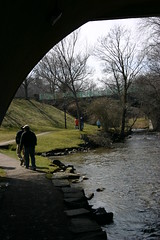
After seeing Plymouth Rock, a short walk down the street brings you to the entrance of Brewster Gardens where you can walk up along Town Brook where the first garden plots of the Plymouth Plantation were planted and where fresh water was available to the Pilgrims and explore another portion of the Pilgrim Memorial State Park. The gardens run from Water Street along the shore to the Grist Mill along Summer Street.

There's a paved trail that makes its way through the gardens, which are home to Town Brook, along with a sculpture, the springs that provided water to the Pilgrims and several places to stop and sit and enjoy the scenery. The entire walk only takes about 5 minutes at a fairly leisurely pace, so the gardens aren't that big. The most open area is adjacent to Water Street, where the gardens form a fairly wide park around Town Brook.

The trail from Water Street loops around the larger portion of the park and then crosses Town Brook and makes its way upstream along the brook's edge. You'll pass under the bridge for Main Street and Pleasant Street. Along this section, the freshwater springs that provided water for the Pilgrim literally pour out the sides of the hill into the brook.

The Gardens narrow as they approach the Grist Mill where they end. You can continue following Town Brook through the Jenney Pond Park. This park is also home to the Grist Mill.

If you get to the Brewster Gardens at the right time of the year in the spring, you can watch the herring swim upstream from the ocean as they try to reach their spawning ground. I was there in mid-March and it was too early for the herring run.

Experiences

The last time I was in Plymouth we got out, saw Plymouth Rock, toured the Mayflower II and then headed back home. This time though we took some time to explore the area and I was glad we did. We found Brewster Gardens after walking past Plymouth Rock and down Water Street. The Gardens were a nice area to walk along the brook and to sit down and enjoy the sunshine.

I'd imagine that in the summer, the Gardens look even better since everything will be growing and blooming. We were there in March and even though it wasn't really the growing season, the entire area was really nice to look at and was well maintained. Plus with all the springs coming out along the brook, even the grass seemed greener that early in the season.

I'd definitely go back to the Brewster Gardens, especially to continue along the trail that runs through the Gardens on to Jenney Pond Park and up to the Billington Sea where Town Brook starts.

Final Thoughts

Brewster Gardens isn't a reason to go to Plymouth, however once you are there, it's well worth your time to go and enjoy the gardens and take in some of the history of the area. It's neat to think that this was where the first garden's of the Pilgrims were and where they got their water. In addition, as the replica Grist Mill at the end of the park shows, the water of the Brook was harnessed to run various industries in Plymouth.

I'd suggest going later in the spring or the summer to the Gardens since things will be growing and it's more enjoyable to stroll the park in the warmer weather. We were lucky that it was a warm early spring day so we took our time along the stream and sat and enjoyed the sunshine.

I'd think it would be neat to be there when the herring are swimming upstream, but it might be challenging to plan a trip around when they will be there. I think it's a hit or miss kind of thing in the springtime.

Overall, if you're in Plymouth and exploring the Town's many scenic areas and attractions, spend some time walking along Town Brook in the Brewster Gardens.

More Plymouth, Massachusetts attractions and sites of interest

Thursday, February 07, 2008

Plymouth Rock - Plymouth, Massachusetts

Plymouth Rock
Located along the shoreline in Plymouth, Massachusetts, Plymouth Rock is where the Pilgrims supposedly disembarked and first stepped from their ships to permanently settle. 

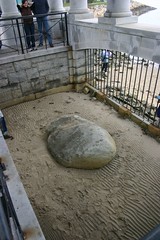
The rock is located directly on the shoreline in Pilgrim Memorial State Park and is surrounded by a granite canopy. The actual rock is about 5 feet below the ground surface, just above the level of the beach in front of it. This lowered area is open to the sea (but protected by bars to prevent people from accessing the rock).

Finding Plymouth Rock 

The rock is located in downtown Plymouth along the shoreline. You can get there either from the north or the south by taking Route 3 and getting off at exit 6 (Route 44), which will take you into downtown Plymouth. Once in the downtown area, signs will direct you to Plymouth Rock, which is located off of Water Street.

We lucked out visiting during the off-season as Plymouth was not crowded and we found parking along the street adjacent to Pilgrim Memorial State Park. However during busier times, it’s likely that only handicapped parking would be available there. In that case, municipal lots are scattered throughout Plymouth and generally even on the most crowded days, parking is available if you search for it.

Plymouth Rock is open to the public at all times and is free to see.

Expectations 

As a Massachusetts resident who wasn’t born and raised here, I missed out on the school trips to Plymouth Rock and the village of Plymouth, which also hosts the replica of the Mayflower and a recreation of the original Plimouth Plantation. So over the years, my idea of what Plymouth Rock probably exaggerated itself in my mind. I was picturing a good sized rock, one that a ship could see from sea and would probably head towards.

It was my partner who kept telling me to think smaller, that Plymouth Rock really wasn’t a big deal and that it wasn’t big or impressive at all.

Taking stock of the rock 

What can I say, he was right.

When we first pulled up and parked, I could see the classically designed granite canopy and granite columns that were surrounding what I assumed to be Plymouth Rock. The rock and canopy are located adjacent to the shoreline and visitors and it’s a quick walk from the dedicated park parking or for those walking along Water Street, is between the street and the shoreline at the southern end of the park.

As I walked over, I thought the rock must be awfully low in the ground, as I wasn’t seeing anything sticking up over the fencing inside the canopy (the area of the rock is closed off to the public, you can only look over the fencing down to the rock). It wasn’t until I got to the railing and looked down that I was like “is that it?”

The rock is quite small, maybe about 4 feet long and about 2 feet wide and is about 5 feet or so below the surface of the sidewalk. The front of the enclosure is open towards the bay and at high tide and during storms, water washes in through the iron bars around the rock.

The viewing area around the rock is fairly large and can hold a number of people, though I would imagine during busier times, you may sometimes have to wait to get up against the fencing to get a good view of the rock. However, there’s not much to look at so after a few moments and perhaps a few pictures, most people will be on their way.

There are informational boards outside of the canopy area, which helps the crowd keep milling around, and which provide a background history of the rock, the Pilgrims and Plymouth.

The rock was apparently a lot more impressive when the Pilgrims landed. At least three times as big as it is now, this stone is the only granite boulder found along the shoreline of Plymouth and was dropped during the glacial times. Over time the elements and people have worn at the rock, by natural processes and by chipping away at it for souvenirs. That’s why it’s protected today from the public – to prevent vandalism.

The rock is also cracked and glued back together (you can see the crack and the glue). In years past they had tried to move the rock and it cracked as they pulled it out. When it was returned to the site, it was glued back together.

What else is there? 

Besides Plymouth Rock, the Pilgrim Memorial Park is also host to the Mayflower replica, The Mayflower II. This boat is maintained by the Plimouth Plantation and is a historical replica of the original Mayflower. There is an admission fee which allows you to enter the dock area which hosts an outdoor museum area and enter the ship and go on a self-guided tour through. There are also actors on the ship, playing the part of the original colonists who will answer questions and take part in demonstrations on the ship.

Outside the park there is the adjacent Brewster Gardens, along with rest of Plymouth, which has plenty of interesting shops, historical points of interest and restaurants. Just beyond the village is the Plimouth Plantation, which is a recreation of the original colony that was settled by the Pilgrims.

Is it worth it? 

Being a history buff, I loved it, even though the rock was, I have to admit, kind of disappointing. I’m not sure what I was expecting, but it wasn’t a little rock down in a hole.

That said, Plymouth Rock is a cornerstone of our American history and is worth the visit, if not for the majesty of the rock, just because of its historical significance. It’s also interesting to learn the history of the rock, of Plymouth and if you take a tour of the Mayflower II, to learn how the colonists made it over from England.

I’d go again in a heartbeat, not so much to just see Plymouth Rock, but to experience everything that makes up the area, including the rock.

Final Thoughts 

Plymouth Rock is part of America’s history and if you combine your visit of the rock with the other activities in Plymouth, you’ll have a great time learning about our history and exploring a beautiful portion of southern Massachusetts.

More Plymouth, Massachusetts attractions and sites of interest